


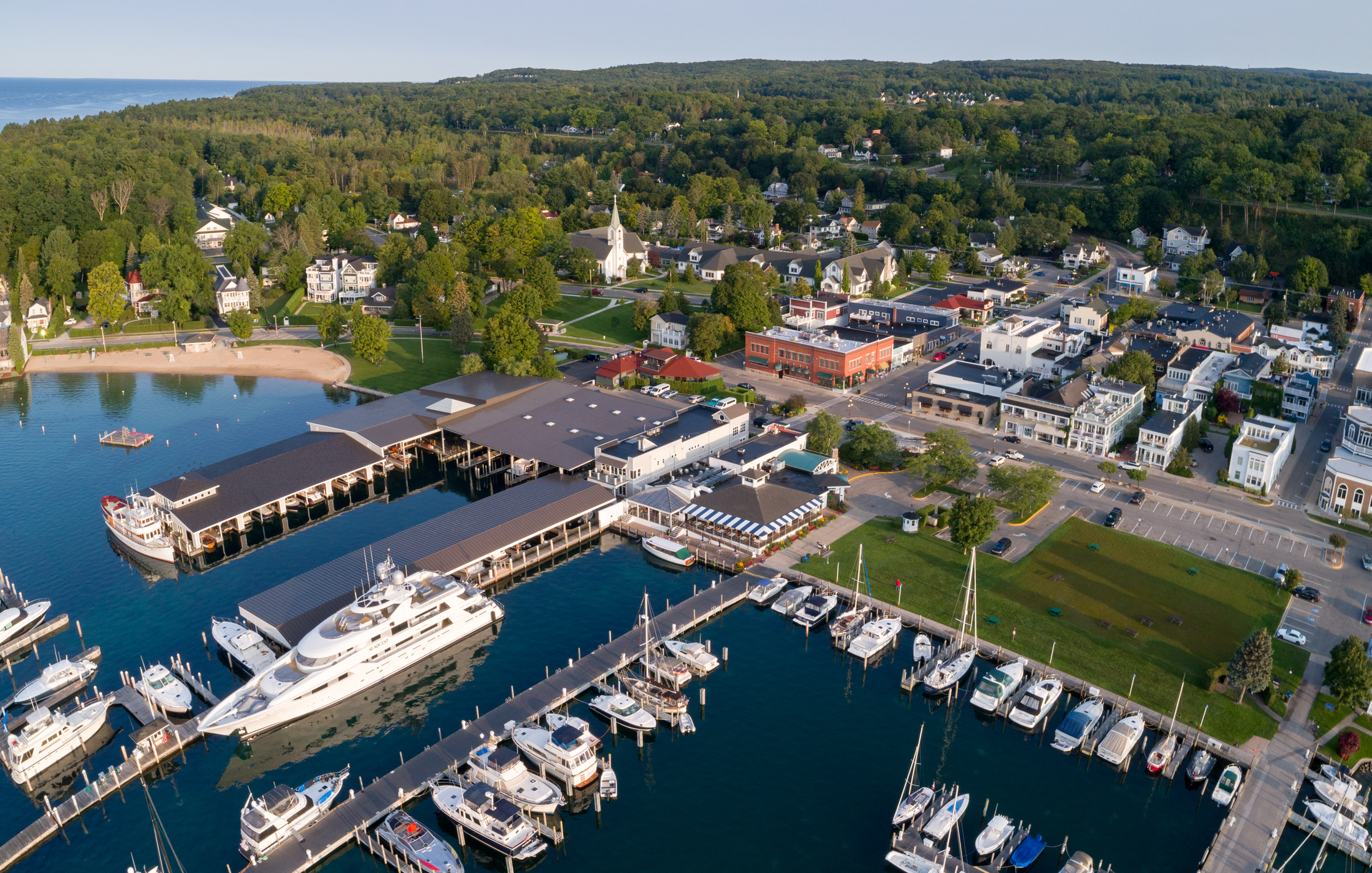
Luxury Homes & Listings in Northern Michigan
The Hartwick Collection


Buying Up North is different
A portal can't answer the questions that matter. Bob and Trish can.


“We came in fixed on Bay Harbor. Bob and Trish opened our eyes to homes across three counties that fit the life we pictured: on the water, near the right course, inside our budget.”
Craig and Patricia Gorsline spent years of summers in Bay Harbor and fell for Northern Michigan one long evening on the water at a time. With a business to run in Miami, they never boarded a plane for the search. Bob and Trish guided them remotely, from the first shortlist to the closing table on their Harbor Springs home.
- Trails they have walked
- Lakes they know by name
- Your experts, first call to close
Local experts. No trip required.
Virtual tours
Live streamed showings
Local legwork
Close from wherever you are
Find your place
Search by the life you want. Hartwick listings appear first.




View Questions
Do we need a local lender?▾︎
What are the steps to buying a home from start to close?▾︎
The home buying process in Northern Michigan follows a clear sequence, and understanding each step upfront removes a lot of the uncertainty. Here's how it typically works:
First, get pre-approved for a mortgage. This establishes your budget, shows sellers you're a serious buyer, and speeds up the process once you find the right property. In many cases, buyers make cash offers which are compelling to sellers.
Second, define your priorities — location, property type, waterfront versus inland, primary versus vacation home — and start searching with your agent. The Hartwicks provide curated property recommendations based on your criteria rather than flooding you with every listing on the MLS.
Third, when you find the right property, your agent prepares a comparative market analysis and sends you a list of offer questions to help prepare the purchase documents. Your agent then prepares and submits an offer that includes price, contingencies, earnest money, and timeline.
Fourth, once the offer is accepted, the inspection period begins — typically 10 to 14 days.
Fifth, the appraisal and final mortgage underwriting proceed in parallel.
Sixth, the title company conducts a title search and prepares closing documents.
Seventh, you do a final walkthrough, sign closing documents, and receive the keys.
Start to finish, this process typically takes 30 to 60 days from accepted offer, with the Hartwicks coordinating every step. The Hartwicks help customers foresee potential hurdles/blockers and strategize early to mitigate friction.
How long does the home buying process take in Michigan?▾︎
In Michigan, the home buying process typically takes 10 to 60 days from accepted offer to closing, though the full timeline from first search to keys in hand can be several months depending on the buyer's situation. The offer-to-close period is driven primarily by the mortgage process — lenders generally need 30 to 45 days for underwriting, appraisal, and final approval. Cash purchases can close in as little as 10 days.
In the Northern Michigan market, a few factors can affect timing. Waterfront property appraisals sometimes take longer because comparable sales are fewer and more spread out geographically. During peak season (May through August), inspectors, appraisers, and title companies are busier, which can add a few days to the process. Winter closings tend to move faster simply because there's less volume.
The Hartwicks advise buyers to get pre-approved before they start looking seriously. Having financing lined up shaves time off the process and strengthens your position when competing with other offers. For out-of-area buyers, the Hartwicks coordinate the entire timeline remotely — inspections, appraisals, document signing — so distance doesn't become a bottleneck.
What is the best time of year to buy a home in Northern Michigan?▾︎
Northern Michigan's real estate market follows a seasonal rhythm that creates distinct opportunities for buyers throughout the year. Spring and summer — roughly March through September — are the busiest seasons. Inventory peaks, open houses are in full swing, and competition among buyers is highest, especially for waterfront properties. If you're looking for the widest selection, this is when you'll find it.
Fall and winter offer a different advantage. Fewer buyers are actively looking, which means less competition and sometimes more room to negotiate on price. Sellers who list in the off-season are often highly motivated. For buyers who can handle a showing when there's snow on the ground, winter can deliver solid value — particularly on inland properties and homes that have been on the market through the summer months.
Bob and Trish advise their customers to focus less on timing the market and more on being financially prepared when the right property appears. In a market with limited waterfront inventory and strong demand from out-of-area buyers, the best time to buy is when you're pre-approved and ready to move. Waiting for a "perfect" season can mean missing the property that checks every box.
Where can I find good value in Northern Michigan real estate?▾︎
The headline communities (Petoskey, Harbor Springs, Bay Harbor, Charlevoix) get the most attention, but Northern Michigan has smaller communities and inland lake areas that offer strong quality of life at lower price points. Buyers open to being a short drive from the marquee towns can find properties priced well below the headline areas.
Consider communities like Boyne City (south arm of Lake Charlevoix, walkable downtown), East Jordan and Ellsworth (minutes from Torch Lake and Lake Charlevoix), Alanson/Conway/Oden (quiet inland living, easy access to Petoskey and Crooked Lake), Pellston (small village in Emmet County), Boyne Falls (home of the Midwest’s largest ski area at Boyne Mountain), and the Indian River/Cheboygan/Mullet Lake corridor (lakefront at accessible price points).
The Hartwicks know which communities are gaining interest, which offer solid long-term value, and which have the infrastructure (year-round road maintenance, reliable internet, proximity to healthcare and schools) that makes ownership practical. They can match your budget to communities that deliver both lifestyle and value.
What is earnest money and how much do I need?▾︎
Earnest money is a deposit made by the buyer after an offer is accepted, signaling serious intent to complete the purchase. It's sometimes called a "good faith deposit." The funds are held in an escrow account, typically managed by the title company, and applied toward the buyer's closing costs or down payment at closing.
In the Northern Michigan market, earnest money deposits typically range from 1% to 10% of the purchase price, though the amount is negotiable. On a $500,000 property, that's usually $5,000 to $50,000. For higher-end or waterfront properties, sellers may expect a larger deposit as a sign of commitment. These are general ranges — the specific amount is part of the offer negotiation.
If the transaction proceeds normally and closes, the earnest money simply becomes part of your payment. If the deal falls through due to a contingency written into the purchase agreement — such as a failed inspection, financing denial, or appraisal shortfall — the buyer typically receives the earnest money back. The Hartwicks walk their customers through every contingency before an offer is submitted, so the terms are clear and protective. The specific amount is part of the offer negotiation, and the Hartwicks advise their customers on the deposit level that will strengthen their position.
What happens during a home inspection?▾︎
A home inspection is a thorough examination of a property's condition, conducted by a licensed inspector after an offer is accepted. The inspector evaluates the home's major systems and components: roof, foundation, electrical, plumbing, HVAC, insulation, windows, doors, appliances, and the overall structure. The inspection typically takes two to four hours depending on the property size, and buyers are encouraged to attend.
In Northern Michigan, inspections often include considerations specific to the region. Waterfront properties may need additional assessments for septic systems, well water quality, seawall condition, and dock structures. Older homes — common in communities like Bay View and downtown Petoskey — may have unique issues related to foundation settling, outdated wiring, or insulation that doesn't meet current standards.
After the inspection, the inspector provides a written report detailing findings. The Hartwicks review this report with their customers and help them distinguish between major concerns that warrant negotiation and minor maintenance items that are typical for the property's age and type. A good inspection doesn't kill deals — it gives buyers the information they need to make smart decisions.
What are typical closing costs for homebuyers in Michigan?▾︎
Closing costs for homebuyers in Michigan vary based on purchase type. For cash transactions, costs are minimal — typically around $500 for closing company fees, recording fees, and mailing costs. For financed purchases, closing costs typically run between 2% and 5% of the purchase price, depending on the loan type, lender fees, and local factors. On a $500,000 home, that means roughly $10,000 to $25,000 in costs beyond the down payment. These are estimates and vary by transaction.
Loan acquisition costs generally run around 1% of the loan amount, varying by loan type. The major line items include lender origination fees, appraisal, title insurance (both lender's and owner's policies), title search and examination, recording fees, escrow setup, prepaid property taxes, and homeowner's insurance. Michigan does not have a transfer tax on the buyer side — the seller pays the state transfer tax at closing. However, buyers should budget for prorated property taxes depending on the closing date.
One cost that catches some out-of-area buyers off guard is Michigan's uncapping of property tax assessments upon sale. When a property changes hands, the taxable value resets to the state equalized value, which can result in a higher annual tax bill than the previous owner was paying. The Hartwicks make sure their customers understand this before they make an offer, so there are no surprises after closing.
What should out-of-area buyers know about buying a home in Northern Michigan?▾︎
Out-of-area buyers are a major part of the Northern Michigan real estate market. The Hartwicks estimate that 60% of their customers are purchasing from outside the area, many from suburban Detroit — historically the largest source of buyers in this market — along with Illinois, Florida, and Texas. This is not unusual here — local agents are experienced with remote transactions and the process is well-established.
The most important thing out-of-area buyers should know is that having a strong local team matters more here than almost anywhere. Your agent needs to be your eyes and ears on the ground — previewing properties, flagging issues that don't show up in photos, understanding hyper-local market dynamics like which side of a lake gets afternoon sun or which roads are maintained year-round. The Hartwicks regularly conduct video walkthroughs, provide detailed property assessments, and coordinate inspections, appraisals, and closings for buyers who can't be physically present.
Other practical considerations include understanding Michigan's property tax structure (which differs from many other states), winterization and seasonal maintenance requirements, homeowner's insurance in lake and flood zones, and the availability of reliable internet and utilities in more rural areas. These are all things a knowledgeable local agent will walk you through before you make an offer.
Can I buy a home in Northern Michigan if I live out of area?▾︎
Absolutely. Out-of-area buyers make up a significant portion of the Northern Michigan real estate market, and the Hartwicks estimate that roughly 60% of their customers purchase from outside the area. Buyers come from all over — suburban Detroit has historically been the largest source, with growing numbers from Texas, Florida, Chicago, and beyond. There are no residency requirements for purchasing property in Michigan, and the entire process can be managed remotely with the right team.
The key is having a local agent who can serve as your representative on the ground. The Hartwicks handle every aspect of the transaction for their out-of-area customers: property previews via video walkthrough, detailed assessments that go beyond listing photos, coordination of inspections and appraisals, document management through secure digital platforms, and even remote closings when needed.
Mortgage pre-approval can be obtained from lenders in your home state or from Michigan-based lenders — either works. Some buyers prefer working with a lender who knows the Northern Michigan market, while others find it more convenient to use their existing banking relationship. The Hartwicks can provide referrals either way. Living out of area does not put you at a disadvantage when you have a team that specializes in making the process seamless.
How does the remote home buying process work?▾︎
The remote buying process follows the same fundamental steps as an in-person purchase, with technology and a strong local team filling the gaps created by distance. It starts with a detailed conversation about your priorities — location, budget, property type, intended use — so the Hartwicks can search strategically rather than sending you every listing in the MLS.
When properties of interest are identified, the Hartwicks conduct video walkthroughs that go far beyond the marketing photos. They'll show you what the listing doesn't — the view from the dock, the neighbor's property, the road noise level, the cell signal strength, the condition of the driveway in winter. These are the details that matter when you can't visit in person.
Once you've identified a property, the offer, negotiation, inspection, and closing processes are all managed digitally. Inspections are attended by the Hartwicks on your behalf, with real-time photo and video updates. Documents are signed electronically through secure platforms. Many Michigan title companies offer remote notarization and closing options. The Hartwicks have closed hundreds of transactions this way and have refined the process to be as smooth as an in-person deal.
What should Chicago-area buyers know about buying in Northern Michigan?▾︎
Chicago-area buyers are one of the largest segments of the Northern Michigan real estate market, and for good reason — Petoskey, Harbor Springs, and Charlevoix are about a four-and-a-half-hour drive from the northern suburbs, making them accessible for long weekends without requiring a flight. Many Chicago families have vacationed in Northern Michigan for generations and eventually make the move to owning property.
A few things to be aware of. Michigan's property tax system works differently from Illinois. When a property changes ownership, the taxable value resets (uncaps) to the state equalized value, which can result in a significantly higher tax bill than the previous owner was paying. This is a common surprise for out-of-area buyers. On the positive side, Michigan's overall property tax rates in the Petoskey-Harbor Springs-Charlevoix area are generally lower than what Chicago-area homeowners are accustomed to.
Other considerations include understanding seasonal road conditions (US-31 and I-75 are your primary routes, and winter weather can add time), utility availability in more rural areas (some properties rely on well water and septic rather than municipal systems), and internet connectivity, which varies by location. The Hartwicks work with buyers from across the Midwest and beyond, and understand the comparison points that matter regardless of where you’re coming from.
How can I evaluate a property I can't visit in person?▾︎
Evaluating a property remotely requires a combination of technology, a trustworthy local agent, and the right questions. The Hartwicks provide their out-of-area buyers with detailed video walkthroughs that cover everything the listing photos don't: the approach to the property, the view from every window, the condition of mechanical systems, the feel of the neighborhood, and the things you'd notice if you were standing in the driveway.
Beyond video, the Hartwicks provide written assessments that include observations about condition, potential issues, neighborhood context, and how the property compares to similar listings they've recently shown or sold. They'll share information about the road (paved or gravel, county-maintained or private), proximity to town, cell signal and internet availability, and seasonal factors like snow load or water levels.
For buyers who can make one trip, the Hartwicks structure visit days to maximize efficiency — previewing properties in advance so the in-person tour focuses on the top candidates. For buyers who truly can't visit before making an offer, the inspection contingency in the purchase agreement provides protection. The Hartwicks attend every inspection and provide detailed reporting, so you can make a fully informed decision about whether to proceed, negotiate, or walk away.
What is a virtual tour and how reliable is it for home buying decisions?▾︎
A virtual tour is a digital walkthrough of a property, typically created using 3D scanning technology (like Matterport) or high-quality video. Matterport tours allow you to navigate through a home at your own pace, moving room to room and zooming in on details. Video tours, either pre-recorded or live via FaceTime or Zoom, provide a guided experience where the agent controls the camera and can respond to questions in real time.
Virtual tours are a valuable tool, but they have limitations. They excel at showing layout, flow, room sizes, and the overall condition of a property. They're less effective at conveying the feel of a neighborhood, ambient noise, natural light quality at different times of day, smells (like musty basements or fresh lake air), and the small details that you'd catch during a physical walkthrough.
The Hartwicks use virtual tours as one component of their remote buyer process, not the only one. They supplement tours with detailed written assessments, targeted photos of areas not well-captured by the tour, and candid observations about the property's strengths and weaknesses. For their out-of-area customers, this layered approach provides enough information to make confident decisions — especially when combined with a strong inspection contingency that protects the buyer if on-site evaluation reveals issues the virtual tour couldn't show.
What ongoing home maintenance should remote owners plan for?▾︎
Remote homeownership in Northern Michigan requires a maintenance plan, especially if the property sits vacant for portions of the year. The biggest risks during absence are frozen pipes, water intrusion, and storm damage — all of which can escalate quickly if nobody is checking on the property.
At minimum, remote owners should arrange for regular property checks (weekly or biweekly during winter), snow removal service for driveways and walkways, and a reliable local contact who can respond to emergencies. Many remote owners install smart home monitoring systems that track temperature, humidity, and water leaks, providing alerts to your phone if conditions change unexpectedly.
Seasonal maintenance tasks include fall winterization (draining irrigation systems, pulling docks, shutting off exterior water lines), spring opening (reconnecting systems, dock installation, gutter cleaning), and ongoing items like lawn care, HVAC filter changes, and pest prevention. For waterfront properties, add seawall inspection, dock maintenance, and shoreline monitoring. Budget approximately $3,000 to $8,000 annually for seasonal maintenance and property management, depending on property size and complexity. The Hartwicks maintain a network of trusted local contractors and property management contacts and can help remote owners build a reliable maintenance team. These are estimates and vary by property.
Let's find your home together
Make an Appointment
Thirty minutes with Bob and Trish, in person or by video.
Make an AppointmentPrefer to call? 231-242-3423
Own a home Up North?
See what the Hartwicks' marketing does for the homes they represent.
IDX information is provided exclusively for consumers' personal, non-commercial use, it may not be used for any purpose other than to identify prospective properties consumers may be interested in purchasing. The data is deemed reliable but is not guaranteed accurate by the MLS. © 2026 NM-MLSX.